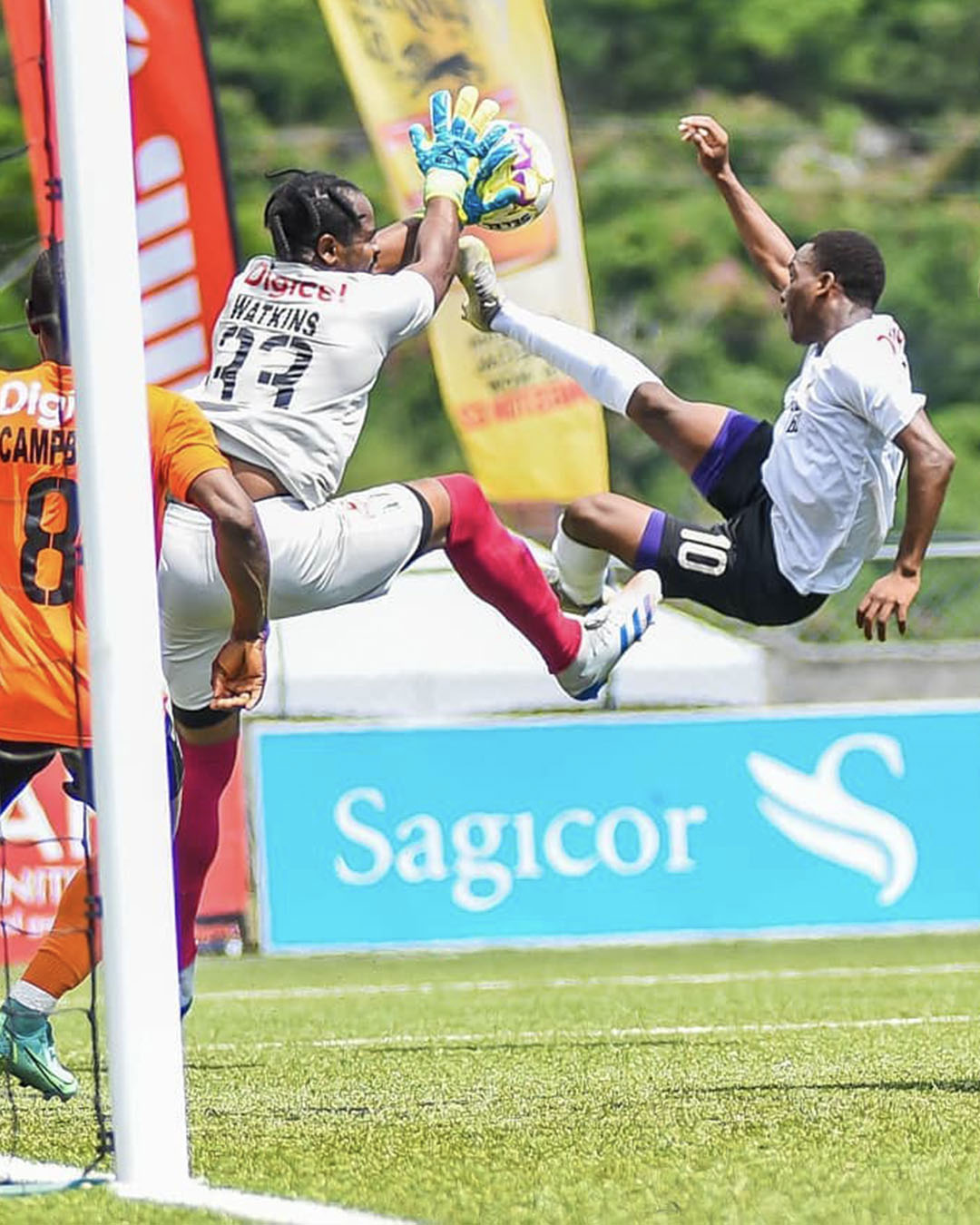
Every January, the island loses its mind over schoolboy football. Manning Cup, DaCosta Cup, the Inter-Secondary Schools Boys and Girls Championship — the passion is real, the talent is undeniable, and the future looks bright. Then the season ends. The headlines fade. And somewhere between the final whistle of a schoolboy semifinal and the opening day of the Jamaica Premier League, we lose them.
Not all of them. But far too many.
The pipeline from schoolboy football to the JPL is not leaking. It is broken. And until we stop pretending otherwise, we will keep producing spectacular teenagers who become invisible adults.
The Talent Is Not the Problem
Let’s get this out of the way immediately: Jamaica does not have a talent deficit. Walk into any schoolboy final at the National Stadium and you’ll see things that would make European academy scouts salivate. Speed, physicality, creativity, an instinct for the ball that you cannot coach into a player — it’s either there or it isn’t. And in Jamaica, it’s there in abundance.
The problem has never been the raw material. The problem is what happens to the raw material when there is no factory to refine it.
Consider the numbers. Each year, schoolboy football produces dozens of standout performers across multiple competitions. Players who dominate their age groups, who attract attention from scouts, who are talked about as the next big thing. Now ask yourself: how many of those players are playing in the JPL two years later? How many are playing anywhere professionally five years later?
The attrition rate is staggering. And it’s not because the players suddenly forgot how to play. It’s because the system they graduate into is not equipped to develop them further.
The Coaching Gap
Schoolboy football coaching in Jamaica is a mixed bag. Some schools — the traditional powerhouses — have dedicated, experienced coaches who understand player development. Many others rely on teachers who double as coaches, volunteers with passion but limited tactical education, or former players who coach based on instinct rather than methodology.
That’s fine at the schoolboy level, where raw athletic ability can compensate for tactical naivety. But when a player steps into the JPL — or worse, tries to trial abroad — the gaps in their development become glaring. Positional discipline. Off-the-ball movement. Decision-making under pressure. Tactical awareness in different formations. These are not luxuries. These are the baseline requirements of professional football anywhere in the world.
The coaching quality gap between schoolboy football and the JPL is enormous. And there is virtually no bridging mechanism — no structured academy system, no development league, no intermediate stage where an 18-year-old can go to receive the coaching that will turn natural talent into professional competence.
The Infrastructure Deficit
You cannot develop professional footballers on pitches that would embarrass a Sunday league in any other country. Full stop. And yet that is exactly what the JPL asks its clubs to do.
The facilities available to most JPL teams are inadequate by any reasonable standard. Training grounds with uneven surfaces. No gym facilities. No video analysis rooms. No sports science support. No nutritional guidance. The players are expected to develop into professionals while training in conditions that professionals in other countries would refuse to work in.
For a young player coming out of schoolboy football — already under-coached tactically — this environment does nothing to close the gap. If anything, it widens it. The critical development window between 17 and 21, when a player’s tactical brain is most receptive to coaching, is wasted.
Compare this to what other small nations have done. Iceland — a country with a population smaller than Kingston — invested in indoor training facilities across the country and produced a generation of players who qualified for the European Championship and the World Cup. Costa Rica built a centralised academy system that consistently develops players for top European leagues. Even Trinidad and Tobago, with similar resource constraints, has invested more consistently in dedicated football development infrastructure than Jamaica has.
The Track and Field Question
Here’s the part nobody wants to talk about. Every year, the schoolboy football pipeline loses some of its best athletes not to football at all, but to track and field. And can you blame them?
Track and field in Jamaica has a clearly defined pathway: Champs to national championships to international meets to professional contracts or American college scholarships. The incentive structure is visible and functional. A fast 16-year-old sprinter can look ahead and see exactly how to turn speed into a career.
A talented 16-year-old footballer in Jamaica looks ahead and sees… what, exactly? The JPL, where wages barely cover transportation costs? The hope of a trial abroad, arranged through informal connections rather than any systematic scouting network? The dream of a scholarship to an American college, which usually means playing in a system that bears no resemblance to professional football?
The rational choice for a multi-sport athlete in Jamaica is almost always track and field. The pathway is clearer, the financial upside is greater, and the support system actually exists. Football loses talented athletes not because they don’t love the sport, but because the sport hasn’t built a structure that makes choosing it a viable career decision.
What Small Nations Have Done Right
The solutions are not mysterious. They exist. Other nations with similar or smaller populations and comparable economic constraints have implemented them successfully.
Iceland’s model: Invest in coaching education first. Iceland trained hundreds of UEFA-licensed coaches and put them in schools and community clubs. The result was a dramatic improvement in the technical and tactical quality of young players before they even reached the professional level. Jamaica could adopt a similar approach — targeted investment in coaching education, with the goal of having at least one qualified coach in every major schoolboy programme.
Belgium’s model: A centralised technical philosophy that runs from youth development to the senior national team. Every coach at every level teaches the same principles, the same formations, the same style of play. Players moving through the system don’t have to relearn football at each stage. They build on a consistent foundation. Jamaica’s football federation could define a national playing philosophy and ensure it’s implemented from schoolboy level through the JPL and into the Reggae Boyz setup.
Costa Rica’s academy system: A dedicated national academy that identifies the most talented young players and provides them with full-time professional development — coaching, education, nutrition, sports psychology — from age 14 onwards. This is the bridge that Jamaica is missing. A national academy, even a modest one, would catch the best schoolboy players at the point where they currently fall through the cracks.
The Money Question
All of this requires money. And Jamaica is not a wealthy country. But the argument that we can’t afford to invest in football development is undermined by two realities. First, we clearly can afford to invest in track and field, and we do — with spectacular results. The resources exist; they’re just allocated differently. Second, the cost of not investing is paid in lost potential, lost export revenue from player transfers, and a national team that consistently underperforms relative to the talent available on the island.
A single Jamaican player succeeding at a top European club generates more revenue through transfer fees and visibility than the entire JPL budget. The investment case is not just emotional — it’s economic.
Fix It or Stop Pretending
Every year, we go through the same cycle. Schoolboy football produces excitement. We celebrate the talent. We talk about the future. And then we watch that future dissolve because there is no pathway to catch it.
The pipeline is broken. It has been broken for decades. And patching it with good intentions, sporadic initiatives, and the occasional viral clip of a schoolboy wonder goal is not going to fix it.
What will fix it is infrastructure, coaching education, a national academy, and a JPL that pays its players enough to make football a viable career. None of this is impossible. Other nations have done it with less. But it requires a level of commitment and sustained investment that Jamaica’s football leadership has never demonstrated.
So here is the challenge: fix it. Build the pipeline. Give those schoolboy stars a path that doesn’t dead-end at 19. Or stop pretending that we care about developing Jamaican footballers, because right now, the system says we don’t.