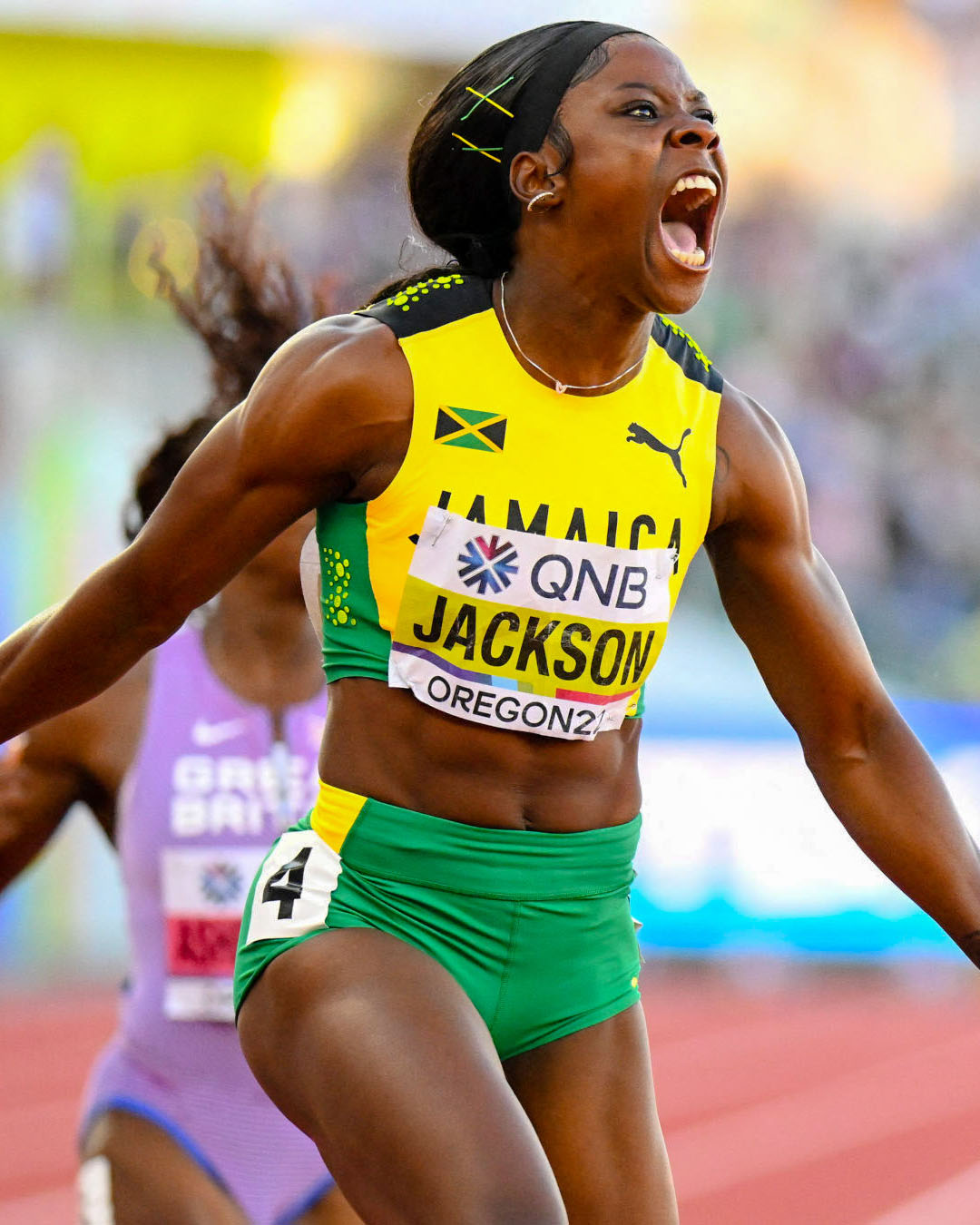
The Diamond League is where regular-season track and field becomes appointment viewing. The world’s best athletes, the sport’s grandest stages, and the kind of performances that set the tone for championship seasons to come. And for Jamaica — a nation that has treated the sprint events as a birthright for the better part of two decades — the Diamond League circuit is a proving ground.
This season, there are five Jamaicans who deserve your attention from the very first gun. Athletes at different stages of their careers, in different events, but united by one thing: the potential to do something special in 2026.
1. Kishane Thompson — 100m / 200m
Let’s start with the obvious one. Kishane Thompson has gone from promising domestic sprinter to genuine global threat in what feels like the blink of an eye — which, given his event, is an appropriate metaphor.
Thompson’s rise has been built on a combination of raw physical gifts and increasingly refined technical execution. He’s tall for a sprinter, which gives him a stride length advantage once he gets upright, but his start has improved dramatically over recent seasons. The result is an athlete who is dangerous from gun to tape — fast out of the blocks, explosive in the drive phase, and powerful through the line.
What makes Thompson’s Diamond League season particularly compelling is the context. This is no longer about potential. He’s run the times that demand he be taken seriously as a contender for global sprint titles. The Diamond League will be the stage where he tests himself against the very best on a consistent basis — not just at one championship, but week in, week out across the circuit.
The question isn’t whether Thompson is fast enough. It’s whether he’s ready for the mental and physical demands of being the hunted rather than the hunter. When you’re the name everyone circles on the start list, the pressure shifts. The Diamond League will tell us whether Thompson can handle it.
2. Oblique Seville — 100m
If Thompson is the explosive power, Seville is the relentless consistency. Over the past two seasons, Oblique Seville has established himself as one of the most reliable sub-10-second sprinters in the world — a man who turns up, executes, and delivers times that would win most races on any given night.
Seville’s strengths are almost the opposite of the stereotypical Jamaican sprinter. He’s not the biggest or the most physically imposing. But his reaction time is elite, his acceleration phase is devastating, and his ability to maintain top-end speed through the final 30 metres of a race is what separates him from the field. He doesn’t overpower opponents — he outruns them with precision and efficiency.
The Diamond League has been kind to Seville in recent seasons, and this year should be no different. He thrives in the meet-to-meet format — the quick turnarounds, the varying conditions, the need to race well repeatedly rather than peak for a single championship. Watch for his consistency across the European circuit. If he’s running sub-9.90 with regularity, that tells you the trajectory is still upward.
Seville doesn’t get the same headlines as some of his compatriots. That’s fine with him. He lets the times do the talking, and the times have been speaking loudly.
3. Ackera Nugent — 100m Hurdles
Jamaica’s sprint hurdles tradition has produced some of the most technically brilliant athletes in the event’s history, and Ackera Nugent is the latest in that lineage. After emerging through the collegiate system and immediately making an impact on the global stage, Nugent enters the 2026 Diamond League as one of the most exciting young hurdlers in the world.
What sets Nugent apart is the combination of raw speed and hurdling technique. Many sprint hurdlers have one or the other — they’re either fast athletes who hurdle adequately, or technically gifted hurdlers who lack flat speed. Nugent has both. Her sprint speed between the barriers is elite, and her clearance technique — low, efficient, barely breaking stride — is the product of coaching that has refined natural talent into competitive weaponry.
The Diamond League is where Nugent can establish herself as the face of women’s sprint hurdling for the next Olympic cycle. The competition is fierce — this is one of the deepest events in women’s track and field — but Nugent has the ability to not just compete at the top, but to win consistently. If she can string together a season of performances in the 12.3-12.4 range, the world will take notice in a way that transcends the track and field community.
For Jamaican athletics, Nugent represents something important: proof that the island’s talent pipeline extends well beyond the flat sprints. The hurdles are Jamaica’s next frontier, and Nugent is leading the charge.
4. Roje Stona — Discus
Here’s a name that casual track and field fans might not immediately associate with Jamaican athletics, and that’s exactly why Roje Stona’s Diamond League season matters. Jamaica is a sprint nation in the public imagination, but Stona is proof that the island’s athletic talent extends into the field events — and extends spectacularly.
Stona’s emergence as a world-class discus thrower has been one of the most compelling stories in recent Jamaican athletics history. The throws events have never been Jamaica’s traditional strength, which makes Stona’s ascent all the more remarkable. He hasn’t just broken into the global elite — he’s done so with the kind of performances that demand attention and respect from the established European and American throwers who have dominated the event for decades.
What makes Stona’s trajectory so exciting is his margin for improvement. He is still relatively young in discus terms — an event where athletes often don’t reach their peak until their late twenties or early thirties. The technical refinements he’s making season by season, combined with his natural power and athleticism, suggest that his best throws are still ahead of him.
Watch for Stona to make statements early in the Diamond League season. The discus is an event where momentum matters — big throws breed confidence, and confidence breeds bigger throws. If he can establish himself in the top three early in the circuit, the rest of the field will be chasing him all summer.
5. Nickisha Pryce — 400m
The 400 metres has always been a Jamaican event. From the glory days of the men’s quarter-mile dominance to the women’s sustained excellence, Jamaica has produced a seemingly endless supply of athletes who can run the full lap at world-class level. Nickisha Pryce is the latest in that tradition, and her Diamond League season could be the one that elevates her from emerging talent to established star.
Pryce’s progression over recent seasons has been textbook — the kind of steady, sustainable improvement that suggests genuine development rather than a single-season spike. Her times have come down consistently, her racing IQ has matured, and her ability to manage the tactical demands of the 400m — the balance between going out hard and having enough left for the final straight — has improved with every championship round she’s contested.
The Diamond League 400m fields are brutally competitive, which is exactly the environment Pryce needs. Racing against the best in the world on a regular basis — not just at one major championship, but across a full season — is what separates good athletes from great ones. The question for Pryce this season is whether she can translate her championship form into Diamond League consistency.
If she can, the implications extend beyond individual results. Jamaica’s women’s 4x400m relay is always a medal contender at major championships, and having another sub-50-second athlete in the pool makes that relay even more formidable. Pryce isn’t just running for herself — she’s running for the relay squad, for the programme, and for the next generation of Jamaican quarter-milers watching from home.
The Bigger Picture
Five athletes, five events, one nation. What connects Kishane Thompson’s explosive 100m power with Roje Stona’s discus technique is the same thing that has always connected Jamaican athletes across disciplines: a culture that produces competitors. Not just athletes — competitors. People who want to win, who race rather than just run, who throw rather than just participate.
The Diamond League is the circuit that rewards that mentality. Every meet is a battle. Every race is an opportunity to make a statement. And these five Jamaicans are positioned to make some very loud statements in 2026.
Watch them. Follow the results. Track the times. Because when the championship season arrives later this year, you’ll want to say you saw the rise from the beginning.
Jamaica isn’t just back. Jamaica is loaded.